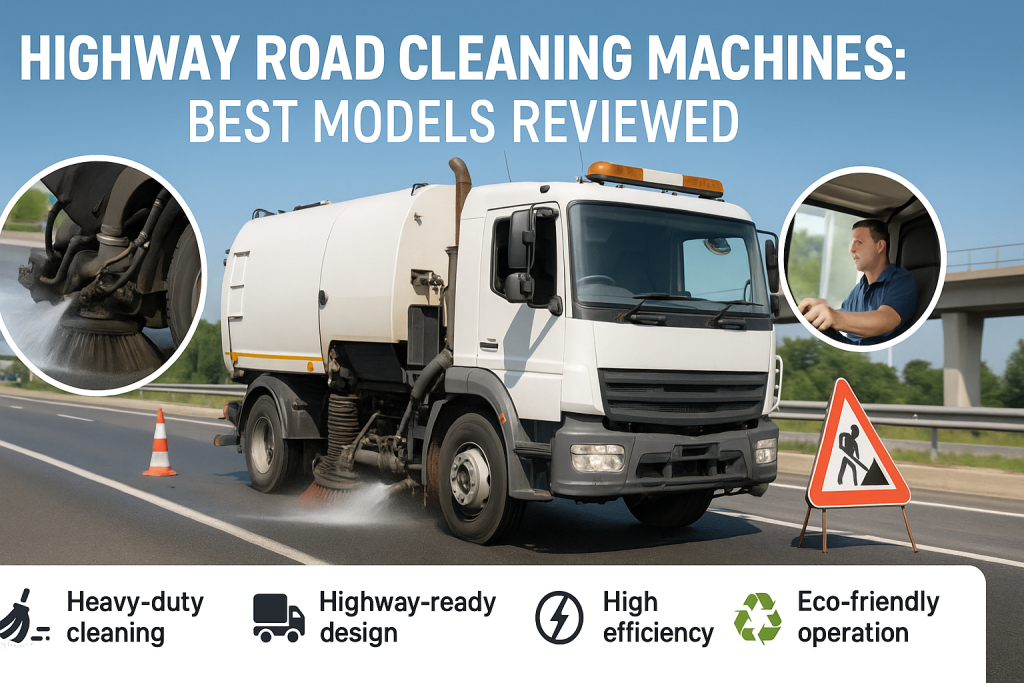
Highway road cleaning machines are essential for maintaining safe and efficient transportation networks. The unique challenges of cleaning major roadways, such as high-speed traffic, heavy debris, and vast surface areas, demand specialized equipment. These machines are built for power, speed, and endurance. They are the heavy-duty workhorses of any public or private road maintenance fleet. This guide provides a detailed review of the types of highway road cleaning machines available. It explores their core technologies and the key features to evaluate when selecting the right model for the demanding task of highway upkeep.
Not all highway sweepers are created equal. Different models use distinct technologies to collect debris. Understanding these core types is the first step in choosing the right machine for a specific application. Each design has its own set of strengths tailored to different kinds of debris and operating conditions.
Mechanical broom sweepers are the classic heavy-lifters of the sweeping world. Their operation is straightforward and incredibly effective for heavy debris. A large, cylindrical main broom rotates underneath the machine, throwing material onto a conveyor system. This conveyor then carries the debris up and into a large hopper. Gutter brooms on the sides pull in material from the edges of the road.
The primary strength of a mechanical sweeper is its ability to handle heavy, packed, and bulky materials. It is the machine of choice for cleaning up after road construction, picking up asphalt millings, and clearing away heavy accumulations of dirt and gravel from road shoulders. Their simple, robust design makes them very durable and reliable in the toughest conditions.
Vacuum sweepers operate on a principle similar to a household vacuum cleaner, but on a massive scale. Gutter brooms gather debris into the path of a large suction nozzle. A powerful fan creates immense suction, pulling the debris up through a large hose and into the hopper. The air is then filtered before it is exhausted to control dust.
These machines are highly effective for general-purpose highway cleaning. They excel at picking up lighter materials such as litter, leaves, and general road grime. Their enclosed system provides good dust control, which is important when working near active traffic. For routine maintenance cleaning of travel lanes and managing seasonal debris like fallen leaves, a vacuum sweeper is an excellent and versatile choice.
Regenerative air sweepers represent a more advanced approach to air-based cleaning. Instead of just suction, these machines use a closed-loop system. A powerful fan blasts a controlled jet of air onto the pavement surface across the entire width of the pick-up head. This blast of air dislodges fine particles and debris. The debris is then immediately drawn up into the hopper on the other side of the head. The air is recycled, or regenerated, back to the blasting side.
The key advantage of this technology is its superior performance on fine particles. It is the best option for removing fine dust, sand, and other small particulates that other sweepers might miss. This makes them ideal for environments where air quality is a primary concern. Regenerative air sweepers also use less water for dust suppression, making them a good choice for dry climates. Their development is a key part of the modern history of the Street Sweeper.
When evaluating different highway road cleaning machines, it is crucial to look beyond the basic type and review the specific performance features. The quality of the chassis, the capacity of the hopper, and the design of the sweeping gear are all critical factors that determine a machine’s effectiveness and longevity.
A highway sweeper is built upon a commercial truck chassis. The quality and specifications of this chassis are fundamental to the machine’s performance. The truck’s engine must provide enough horsepower and torque to allow the sweeper to travel at highway speeds to and from job sites. It must also be powerful enough to handle steep grades and heavy loads. The transmission and suspension systems must be heavy-duty to withstand the constant weight of the sweeper unit and the collected debris.
A well-chosen chassis from a reputable manufacturer also ensures that routine truck maintenance can be performed easily at standard service centers. This simplifies the long-term ownership of the machine. The integration of the sweeper unit onto the chassis should also be seamless and well-engineered.
For a machine cleaning long stretches of highway, the hopper capacity is a critical performance metric. A large hopper means the sweeper can stay on the job longer before it has to stop and travel to a disposal site. This directly translates to increased productivity and lower operational costs. Look for models with the largest possible hopper volume for the given chassis size.
The method of emptying the hopper is also important. A high-dump mechanism is essential for highway applications. This allows the sweeper to lift its hopper and dump the collected debris directly into a dump truck or a large roll-off container. This is far more efficient than dumping on the ground and re-handling the material. The hopper should be constructed from durable, abrasion-resistant steel, with stainless steel options available for better corrosion resistance.
Dust control is a major safety and environmental concern during highway sweeping. All highway road cleaning machines use a water system to spray a fine mist on the debris to prevent it from becoming airborne. Given the long distances covered, these machines must be equipped with large water tanks. Polyethylene tanks are often preferred as they are lightweight and cannot rust.
Review the placement and number of spray nozzles. Effective dust suppression requires water to be applied at the gutter brooms and around the main broom or pick-up head. Some machines offer high-pressure spray bars as an option. These can be used to blast away stubborn, packed-on dirt. A robust and high-capacity water system is a non-negotiable feature for any effective highway sweeper.
The components that do the actual sweeping must be tough and adjustable. The gutter brooms are the first point of contact. Look for models that offer in-cab controls for adjusting the broom’s tilt, rotation speed, and downward pressure. This allows the operator to adapt to changing road conditions on the fly. The main broom on a mechanical sweeper must also be durable and easy to replace.
Many modern sweepers feature quick-change systems for their brushes. This design greatly reduces the time required for this common maintenance task, getting the machine back on the road faster. A well-designed heavy-duty municipal road sweeper will have a sweeping gear system that is both powerful and easy to maintain.
While their primary job is cleaning highways, these powerful machines are also deployed for a variety of other demanding, large-scale cleaning tasks. Their speed, capacity, and durability make them ideal for any situation that requires fast and effective cleanup of large paved surfaces.
Airports have one of the most critical cleaning needs of all. The removal of foreign object debris (FOD) from runways and taxiways is a top safety priority. Any small piece of debris, from a loose bolt to a stray piece of pavement, can cause catastrophic damage to a jet engine. Highway-class sweepers are used for this task because they can clean large areas quickly between flights.
A specialized road sweeper for airports often includes additional features. High-speed vacuum or regenerative air systems are preferred for picking up all types of FOD. Many are also equipped with powerful magnets mounted on the front or rear of the vehicle to collect any metallic debris that could be missed by the brushes.
Large industrial parks have extensive road networks that see constant heavy truck traffic. This leads to the accumulation of mud, gravel, and various industrial materials on the pavement. A highway road cleaning machine is the perfect tool for maintaining these large private road systems. Its capacity and speed make it much more efficient than smaller sweepers.
The durability of a highway sweeper is also a key advantage in this application. It is built to handle the heavy and sometimes abrasive materials found in industrial settings. Keeping the roads clean in these parks is important for safety and for presenting a professional appearance. A powerful road sweeper for industrial parks is a valuable asset for property management.
The cleanup phase of a road construction project is a demanding job. The site is often covered in dirt, rocks, and leftover aggregate. When an old road surface is milled up before repaving, it creates a huge volume of heavy, abrasive asphalt debris. This is a task where mechanical broom sweepers truly shine.
Their powerful brooms and conveyor systems are designed to pick up exactly this type of heavy material. They clear the road surface efficiently, allowing the next phase of construction to proceed on schedule. Their work is essential for preparing a clean, stable base for the new layer of pavement.
When an accident on a highway results in a large spill of non-hazardous material, a road sweeper is often a key part of the response team. A truck overturning and spilling its cargo of sand, grain, or other materials can shut down a highway for hours. A high-capacity sweeper can be dispatched to the scene to quickly clean the debris from the travel lanes.
Their ability to get to a site at highway speeds and then immediately begin working is critical. They can clear a large area much faster than manual methods or other types of equipment. This helps emergency services restore the safe flow of traffic as quickly as possible, minimizing the disruption caused by the incident.
Owning and operating a large highway road cleaning machine is a major undertaking. Beyond the initial purchase price, there are several important factors to review. These include operator safety, long-term costs, maintenance design, and alternative options like contracting.
The operator of a highway sweeper spends long hours behind the wheel, often working at night and alongside high-speed traffic. Their safety and comfort are paramount. The truck cabin should be modern, quiet, and ergonomic. Features like an air-ride seat, climate control, and a logical layout of controls reduce operator fatigue.
Excellent visibility is also crucial for safety. Large windows, well-placed mirrors, and a comprehensive camera system are essential features. The in-cab controls for the sweeping equipment must be easy to use. The operator needs to be able to make adjustments without taking their attention off the road. A machine that is safe and comfortable for the operator will be a more productive machine.
The total cost of owning a highway sweeper goes far beyond its initial price tag. A careful review of all long-term costs is necessary to make a sound financial decision.
A well-designed machine is an easy machine to maintain. When reviewing different models, pay close attention to the accessibility of key service points. Can a mechanic easily reach the engine, hydraulic pumps, and water system? Are the grease points and fluid reservoirs logically grouped and easy to find? A machine that is difficult to work on will have higher labor costs for maintenance and repairs. Good design that considers the needs of the mechanic will save time and money over the life of the sweeper.
For some organizations, owning a large and expensive highway sweeper may not be the most practical solution. Road cleaning contractors offer a valuable alternative. These specialized companies own and maintain their own fleets of high-performance machines. They provide highly trained and experienced operators to perform the work.
Using a contractor can be very cost-effective for entities that have only periodic cleaning needs. It eliminates the high capital cost of purchasing a machine, as well as all ongoing maintenance, storage, and staffing costs. For specialized jobs or to supplement an existing fleet, using contract road cleaning machines is a smart and flexible option.
The technology in highway road cleaning machines is constantly advancing. Modern models incorporate sophisticated systems that improve performance, efficiency, and manageability. Understanding these technologies can help you select a truly state-of-the-art machine.
Many modern highway sweepers can be equipped with telematics systems. These systems use GPS and other sensors to transmit real-time data from the machine back to the fleet manager’s office. This data can include the machine’s location, speed, fuel consumption, and operating hours. It can even report on which sweeping systems are active at any given time. This information is incredibly valuable for optimizing routes, scheduling maintenance based on actual usage, and ensuring operators are working efficiently.
There are two main design philosophies for powering the sweep equipment. The traditional design uses an auxiliary engine. This is a second, smaller engine mounted on the chassis that is dedicated solely to running the hydraulic pumps and fans for the sweeper. This provides maximum sweeping power regardless of the truck’s speed. The alternative is a single-engine, or hydrostatic, design. In this setup, the main truck engine powers everything. A hydrostatic drive system diverts power from the engine to the sweep functions. This design is simpler, lighter, and often more fuel-efficient, but may offer less raw sweeping power. The best choice depends on the primary application.
Beyond standard dust suppression, some highway road cleaning machines offer advanced water systems for specialized tasks. High-pressure spray bars can be mounted on the front or sides of the machine. These systems can blast away heavily caked-on mud or other stubborn materials. Some models offer water recycling systems. These systems filter and reuse the water picked up during sweeping, which can greatly extend the machine’s time on the job before needing to refill its water tanks. There are even systems that can be used to apply liquid dust suppressants or de-icing agents.
Highway road cleaning machines are a critical investment in public safety and infrastructure. By carefully reviewing the core types, key performance features, and advanced technologies, road authorities and contractors can select the best models for their needs. The right machine, whether it is a mechanical, vacuum, or regenerative air sweeper, will provide reliable and efficient performance for years. A well-maintained highway is a safe highway, and these powerful machines are the essential tools to get the job done.
This is the first one.